
Designing loyalty to grow repeat purchases and LTV on Shopify
To grow repeat purchases and LTV on Shopify, you need more than “let’s add points.” This article walks through defining repeat and loyal customers in your own numbers, then designing points, tiers, subscriptions, and messaging you can actually implement in a real Shopify store.
If you want to grow LTV on Shopify, it is usually more cost‑effective to first nail your “repeat purchase” design than to pour money into new acquisition. As ad costs rise, a model that depends only on new customers gets harder and harder. A loyalty program is a structure that tackles this problem at the model level. It needs to be designed as something different from just spraying out discount coupons. This article整理s practical ways to design and implement loyalty in a Shopify store. The key is to define in numbers “who you’re targeting, at which stage, and what you want them to do,” then build perks and communication around that. Let’s break it down step by step.
Redefine “repeat” and LTV using your own numbers
The starting point for loyalty design is to put numeric definitions on “repeat customers” and “best customers” for your own store. If you leave this vague and just drop in a points program, you quickly lose sight of who you are spending how much on, and deep discounts start eating into your profit. First, use historical order data to get a rough sense of patterns. In Shopify’s admin “Customer reports” you can view customers by number of orders. You can also export a CSV and group them in a spreadsheet into buckets like “first‑time only,” “2–3 orders,” “4+ orders,” and so on.
In many stores it is completely normal that more than half of all customers have bought “only once.” At the same time, it is also common to see the top 10–20% of customers accounting for most of the revenue. For example, in one cosmetics subscription store, 18% of all customers had purchased 3 times or more, and that 18% accounted for about 60% of sales. After confirming this kind of structure, you define your own thresholds.
- Repeat customers: have purchased 2 times or more
- Loyal customers: 3 or more purchases per year, or annual spend above XX yen
- At‑risk customers: XX–XX days since last purchase (set based on the typical replacement cycle of your product)
In Shopify, you can use “customer segments” to dynamically create groups like the above by specifying conditions such as order count, total spend, and last purchase date. If you then use these segments as the target audiences for the loyalty tactics described later, day‑to‑day operations become much easier.
Design points and perks around “behavioral steps”
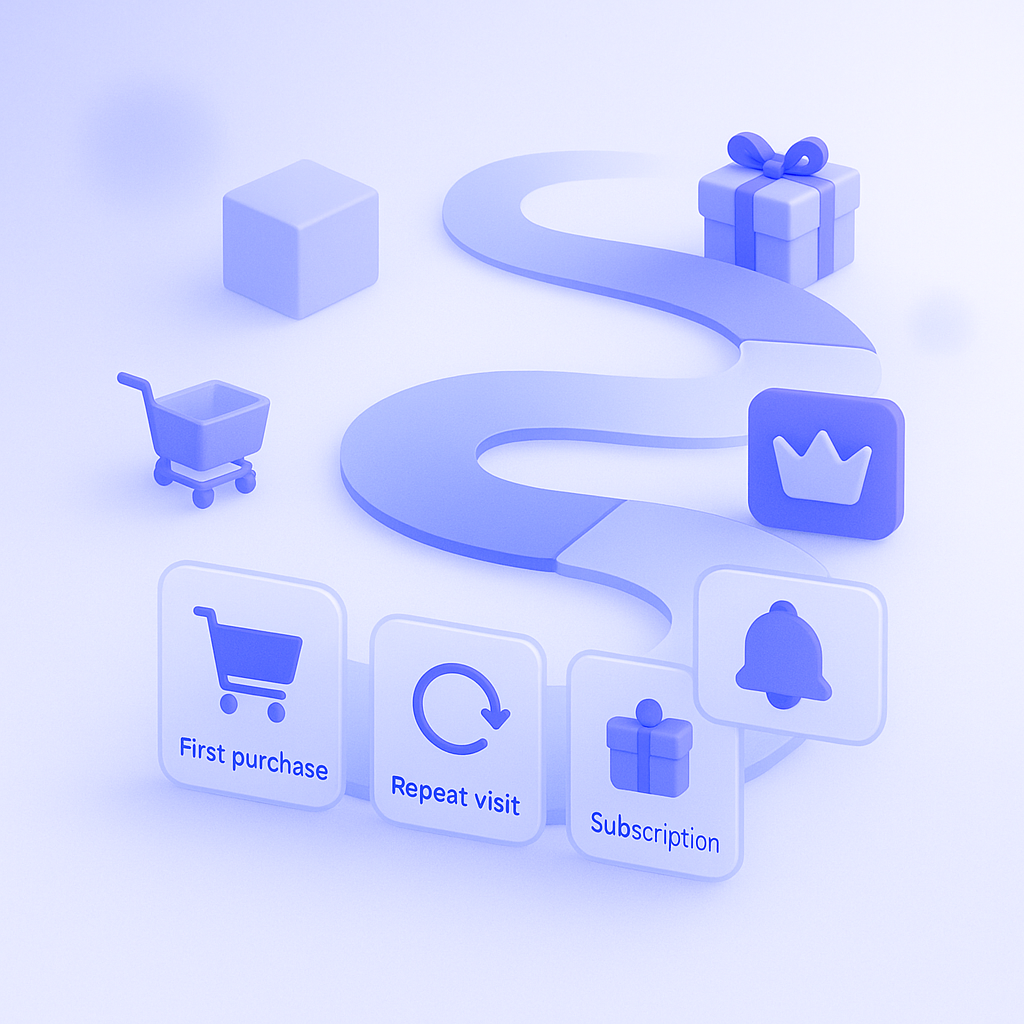
The next thing to clarify is which behaviors you want more of. When people hear “loyalty program,” they tend to start by deciding the point earn rate or discount percentage. But before that, you should map out “which steps you want customers to go through.” For example, you can break it down like this:
- Step 1: Get them to make a second purchase (turn them into a repeater)
- Step 2: Shorten the interval between purchases and/or increase AOV
- Step 3: Turn them into heavy users of your brand (high‑LTV customers)
For each step, think about the “behavioral hurdle” and the “incentive” as a set. For example, the hurdles between first and second purchase can be “they do not know how long it will take to use it up” or “they are not sure what to buy next.” In this case, combining a limited‑to‑second‑purchase point multiplier with recommendations for complementary products tends to work well.
One thing to watch out for: if you structure everything around “always X% points back,” you will likely squeeze your margins. For a product with a 30% gross margin, a constant 10% reward rate means one‑third of your gross profit is going into loyalty. Once you add ad costs and shipping, there is almost no profit left. Make your earn rate as targeted as possible: instead of always‑on rewards, temporarily boost points for specific actions (second purchase, buying in a target category, posting a review, etc.). This makes it easier to balance incentives with profitability.
Use member tiers and VIP design to give customers a reason to stay

Points alone tend to drive “I buy here because it is cheap for now” behavior. To grow LTV, you need customers to feel “the longer I stay, the more I gain” and “this brand values me.” Membership tiers and VIP programs are classic mechanisms for this. Here again, tying them back to the customer definitions you set earlier makes design much easier.
For example, you can set three to four tiers based on annual spend or purchase count, and give each tier clear, easy‑to‑understand benefits.
- Bronze (everyone): standard point earning, newsletter subscription
- Silver (XX yen+ per year): birthday coupon, early access to exclusive sales
- Gold (XX yen+ per year): extra free‑shipping allowances, early access to new products
- VIP (top few percent): invites to exclusive events, priority access to samples, etc.
Common failure patterns include “tier conditions are too complex to understand” and “benefits barely differ between tiers, so there is no motivation to rank up.” In particular, it is easier to explain and operate if you stick to a single axis for conditions, either spend or order count. On Shopify, a typical implementation is to store tier information using customer metafields or tags, or via a loyalty app, and then use the theme to control what is shown per tier and which pages are member‑only. It takes some work to set up, but once the system is in place you can automate a lot of your VIP treatment.
Design subscriptions and recurring orders as the “base layer” of LTV
For products that assume repeat purchase (consumables, food, supplements, cosmetics, etc.), “subscriptions” are a particularly good fit with loyalty programs. If you use an app that supports Shopify’s official subscription APIs, you can sell subscription plans. Subscription customers become the most critical segment for stabilizing LTV.
When designing subscriptions, you should focus on balancing “easy to continue” with “easy to cancel.” If the initial discount is too deep, many people will cancel after the first shipment. In particular, offers like 50% off the first order often lead to a sharp drop in retention from the second order onward. Keep the first‑order discount to around 10–20%, and instead design it so that “the longer you stay, the more you gain” by, for example, increasing the point multiplier for long‑term subscribers. This tends to stabilize LTV over time.
Ease of cancellation is also crucial. A system where customers must call support to cancel may seem to push up LTV temporarily, but the resulting negative reviews and word‑of‑mouth will raise your acquisition costs in the long run. Most Shopify subscription apps allow cancellation and skips from a customer portal. If you add options here like “change next shipment items” or “add items to this shipment,” you can lift both AOV and customer satisfaction.
Use email and app integrations to remind customers at the right time
A loyalty program is not done once it is designed. Without a communication plan to “remind customers at the right time,” the system will simply not be used. On Shopify, you can integrate with email and push notifications (your own app or browser push) to automatically deliver loyalty messages.
At minimum, you should set up the following automations:
- X days after first purchase: usage tips plus recommended products for the second purchase and a point boost
- X days after last purchase (based on replacement cycle): “You might be running low” reminder and a notice of current point balance
- When a member ranks up: a celebratory email and guidance on what it takes to reach the next tier
- Birthday month: a birthday perk announcement and slightly more premium product suggestions than usual
A common pitfall is to attach a discount coupon to every message and end up increasing the total discount rate each time you send email. If you are constantly distributing X% off coupons, full‑price buyers are effectively penalized. Combine non‑price incentives such as point balance notifications, tier benefit introductions, and “recommended just for you” product suggestions so that your messages do not devolve into nothing but discount emails.
How to put this to work with RecoBoost
RecoBoost is a Shopify app that automatically generates product recommendations based on each customer’s browsing and purchase history. Combined with a loyalty program, you can, for example, show “the one item you should buy next” using RecoBoost recommendations on product pages, in the cart, or on the thank‑you page for the segment of customers where you want to increase second purchases. You can also change recommendation logic by member tier or subscription status so that “VIPs see new or higher‑priced items,” while “first‑ to second‑time buyers see easy‑to‑repeat staple products.” A good approach is to design the loyalty mechanics themselves in Shopify or other apps, and let RecoBoost handle “what to propose at each touchpoint,” which makes it easier to lift LTV.
Loyalty design does not start with “shall we add a points system,” but with putting numbers on “which customers, at what timing, and which behaviors you want more of.” Combining Shopify’s customer segments, subscription features, email integrations, and recommendation apps, then iterating on your own version of a loyalty program, is the fastest path to steadily growing repeat purchases and LTV.